| CRATER LAKE
NATIONAL PARK, OREGON
PROFILE |
|
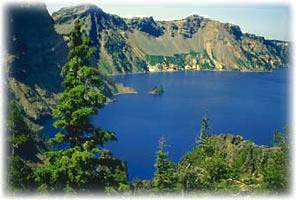
The centerpiece of Crater Lake National Park is the
six mile wide Crater Lake, which lies in the collapsed
caldera of a volcano inside Mount Mazama. Crater Lake
National Park has two visitor centers staffed daily by
park rangers and volunteers. The Steel Information
Center is located at Park Headquarters and is open year
round. Hours: 9:00 a.m. to 5:00 p.m. The park movie is
shown twice hourly. Books, maps, posters, and other
educational materials are available. Backcountry permits
are issued for free.
The Rim Visitor Center is
located at Rim Village, approximately 200 meters east of
the Gift Shop and Café. There are two types of fish that
live in the lake. Other types of fish have been
introduced to this lake but they will not live. The
depth of the lake is quite deep (1943 ft). The lake was
formed when the mountain collapsed from an eruption
which occurred approx 7,700 yrs ago. Perched on the rim
of the caldera, the Center is open daily from June 26
through September 5 from 10:00 a.m. to 6-.00 p.m. From
September 6 through September 30 its hours are 10:00
a.m. to 5:00p.m. Backcountry permits are issued. Books,.
maps. and other educational materials are available for
free.
Sinnott Memorial Overlook and Museum
Built in 1930 and 1931, the Sinnott Memorial
Overlook is located below the caldera rim at Rim
Village. A short but steep path begins near the Rim
Visitor Center. The Overlook and its accompany museum
are available to visitors as staff is available.
Exhibits focus on the history of research on the lake
and the geologic history of historic Mt. Mazama. Ranger
talks relating the formation of Crater Lake are given
from the Overlook daily at 11:00 a.m., 12:30 p.m., 2:00
p.m., and 3:30 p.m from June 26 through September 5th.
Boat Tours
The boat tours are accessible
only by hiking the one mile Cleetwood Cove trail located
on the north side of Crater Lake. It climbs 700 feet in
elevation and is recommended only for those in good
physical condition. It is not recommended if you have
heart, breathing, or leg problems.
Temperatures
on the lake may be much cooler than those at the
trailhead so bring extra clothing and a hat. There is no
water available at Cleetwood Cove. You will need to
bring your own. Composting toilets are available at the
boat dock. A vault toilet is available at the trailhead.
Tickets are purchased at the top of the trail. No
reservations are taken. Allow at least one hour to drive
from Rim Village to Cleetwood Cove parking area and to
hike down the steep trail.
What can we learn
from Crater Lake? Why is it important geologically and
ecologically? And when's the last time you were inside a
caldera? This two hour, ranger lead tour is operated by
the Xanterra Parks & Resorts in cooperation with the
National Park Service to provide visitors with an
expanded knowledge of the lake and its resources,
whether visible, submerged, or intangible. Boat tours
are scheduled to begin in early July - however, inquire
at the park visitor centers to insure correct
information.
Cost: $20.00 for adults $12.00 for
children 11 and under and free for those 24 months and
under. Prices Subject to Change.
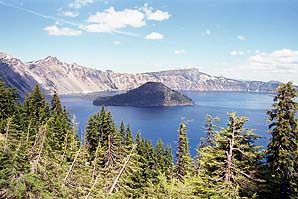 Wizard Island
Options: Wizard Island
Options:
Boats stop at Wizard Island. It is possible
to stay on the island and take a later boat back.
However, your return journey is dependent upon available
space on returning boats. You are not guaranteed a ride
back until the final tour of the day, possibly arriving
at the Cleetwood Dock as late as 6:30 p.m. There are two
hiking trails on Wizard Island. There is no camping
allowed on the Island. Keep in mind that Wizard Island
is a remarkable place: an infant cinder cone with all
the expected hazards: extremely rough lava, loose
cinder, and dry conditions. Use caution when hiking. A
pit toilet is located at the dock area. There are no
other facilities provided for the public on Wizard
Island.
Hiking and Biking
This national
park has over 180,000 acres of which only 11,500 are
taken up by the lake. The remaining 93% is land based,
most of it backcountry. In fact, portions of the park
await designation as wilderness. There are approximately
90 miles of hiking trails in the park -- with each one
offering the visitor a chance to take a closer look at
nature or study a geological feature. You can hike for
several days or wander quietly as long as you like. In
addition to the many trails that start inside the park,
there are several connections with paths in the
surrounding National Forests. A good example is the
Pacific Crest Trail, which runs all the way from the
Mexico to Canada and passes through Crater Lake's
backcountry.
No bicycles are allowed on any park
trails. Bicycling is allowed only on paved roads, the
Grayback Motor Nature Trail, and the dirt trail entering
the park on the east side near the Pinnacles.
Start your trip at the information desk located in the
Steel Center in Munson Valley or the Rim Village
Information Center. Park staff will also issue free
backcountry permits for overnight stays and inform you
of the regulations designed to protect these areas.
Bring plenty of food and water. Wear comfortable
shoes or boots. If you plan on drinking stream water,
you need to treat it with a reliable purification
system. You should also be prepared for any extremes of
weather. Temperatures can change dramatically in the
course of a day. Snow has fallen in all twelve months of
the year here. This information should be helpful in
planning your trip to Crater Lake. Take time to enjoy
the spectacular views of the lake but include time to
relax and enjoy the green forests, cool mountain
streams, and other magnificent features of Crater Lake's
backcountry.
The following is a partial list of
day hikes at Crater Lake National Park. The list is
organized according to estimated time length for
completing the hike. Please note that steep terrain of
Crater Lake means time, length and difficulty are not
directly related. Times are given are estimates of how
long it will take to complete the trail and return to
the trailhead. Trails listed as strenuous should be
taken only by people in good physical condition.
▪ Sun Notch View - Time: 20 minutes, Length: 0.25
miles one way, Elevation: 7000 - 7115 ft., Difficulty:
moderate, Trailhead: 4 miles east of Park HQ on East Rim
Drive, marked by a sign. Feature: Overlook of Crater
Lake and Phantom Ship, scattered wildflowers, dry
meadow. Use caution near steep edges.
▪ Godfrey
Glen - Time: 30 minutes, Length: 1.00 miles, Elevation:
6000 - 6050 ft., Difficulty: easy, Trailhead: 2.4 miles
south of Park HQ.
▪ Castle Crest Wildflower Garden
- Time: 30-45 minutes, Length: .4 mile loop from Rim
Drive, 1 mile loop from Park HQ, Elevation: 6400 - 6500
ft., Difficulty: easy but some uneven ground and rocks,
Trailhead: 1) East Rim Drive, 0.5 miles from park HQ, or
2) Across road from Park HQ parking lot. Features: Small
brook, lush vegetation, and spectacular blooms of
wildflowers in summer months.
▪ The Watchman -
Time: 1 hour, Length: 0.7 miles. one way, Elevation:
7400 to 8056 ft, Difficulty: difficult, steep,
Trailhead: "The Corrals", 3.7 miles northwest of Rim
Village on West Rim Drive. Features: Panorama of
surrounding area, overlook of Wizard Island, a historic
fire lookout and an interpretive map of local peaks and
landforms.
▪ Annie Creek Canyon - Time - 1 hour
and 15 min, Length: 1.7 mile loop, Elevation: 5800 to
6000 ft., Difficulty: moderate, Trailhead: Amphitheater
at Mazama Campground. Features: Deep stream cut canyon,
creek habitats, wildflowers and occasional animals.
▪
Cleetwood Cove (lake shore trail) - Time - 1 hour,
Length: 1.1 miles, one way, Elevation: 6850 to 6176 ft.,
Difficulty, strenuous, 11% grade, Trailhead: Parking
area 4.5 mi. east of North Junction. Features: Access to
lake shore and boat landing.
▪ Garfield Peak -
Time: 2 to 3 hours, Length: 1.7 miles, one way,
Elevation. 7050 to 9060 ft, Difficulty: difficult,
Trailhead: Rim Village Parking Lot. Features: Panorama
of surrounding area, excellent views of Crater Lake,
occasional small animals, wildflowers, and an overhead
view of Phantom Ship.
▪ Mt. Scott - Time: - 3
hours, Length: 2.5 miles. one way, Elevation: 7450 to
8929 ft., Difficulty: - strenuous, Trailhead: 14 miles
east of Park HQ, across East Rim Drive from road to
Cloudcap junction.
Wildlife Viewing
Opportunities
Spring at Crater Lake National
Park- is a very long season or merely a heartbeat,
depending on your perspective. With the disappearance of
the several feet of snow that blankets the area until
early summer, wildflowers bloom, transitory birds
return, trees bud, and animals play in the abundance of
summer. The largest park residents are the deer and elk
that roam the woods of the park from June until October.
A herd of pronghorn antelope also migrate across the
Pumice Desert in the northern end of the park in early
summer as the snow finally leaves the ground. These
ungulates, a word used to describe hoofed animals,
indicate that summer is here; that the plants and trees
are in the midst of their growing season.
Pine
martens, mice, squirrels, and rabbits are just a
sampling of winter wildlife who stay active by feeding
on pine seeds, hemlock bark and other gifts left by
summer's vegetation. Deer must migrate to lower
elevations, sometimes traveling up to thirty miles to
the Rogue Valley where a food supply is still available.
Deer and elk feed mainly on different types of grasses
and lichens, as well as twigs and bark of hemlock,
lodgepole pine, and Douglas fir. Carnivores, or meat
eaters, don't suffer the same food loss as deer when
plants are snowed in.
Elk are the largest of the
park's animals, with females weighing as much as 700
lbs. and males weighing up to 1100 lbs. They commonly
come into the south and western areas of the park as
snow allows, usually around mid-June. The species native
to the park, Roosevelt Elk, were hunted nearly to
extinction in the park by early settlers. To help the
population, 15 elk were from Wallowa County, Oregon.
Oregon's first state game warden, William L. Finley,
brought in 15 elk from the National Elk Refuge in
Jackson Hole, Wyoming, in 1912, to live in a protected
enclosure at Billy Meadows north of Enterprise. Another
15 were brought in 1913. The Crater Lake elk are
descendants of these. The effort was successful; today,
more than 160 elk (approx) have been counted within the
park in recent summers. Deer winter with elk and
generally live in the same regions.
All of these
beautiful animals travel in both daylight and during
evening hours. Please obey all speed regulations and be
very watchful as you travel park roadways for your
safety and theirs. Henry David Thoreau wrote, "Perhaps
what moves us in winter is some reminiscence of far-off
summer. The cold is merely superficial - it is summer
still at the core, far, far within." It is the wakeful
summer core that maintains the sleeping winter of Crater
Lake. Deer and elk are a welcome indication of this
transition.
Camping
There are two
developed campgrounds at Crater Lake. Mazama Campground
is located near the Annie Springs Entrance Station. Lost
Creek Campground is accessed by taking East Rim Drive to
the Pinnacles road. Campsites are all on a first come,
first served basis. No reservations are taken. Camping
opportunities are also available at several locations
outside the park.
Mazama Campground - This 198
site campground is operated by Xanterra Parks & Resorts.
Call 541-594-3704 for prices regarding sites per night.
Fresh water, flush toilets, a dump station, pay showers,
and laundry facilities are available. There are no
utility hookups. Fires are permitted in designated
fireplaces only. Firewood is available for purchase at
the Mazama Store. Campers are allowed to collect only
dead and downed wood. Mazama Campground is open from
June 11 to October 4, 2004, weather permitting.
Lost Creek Campground - A 16 site tents-only campground
is operated by the National Park Service. It normally
opens in July and closes for the season in
mid-September. Check at the park visitor centers at
541-594-3100 for exact opening and closing dates &
rates. Sites are first come-first serve, they do Not
Reserve by phone. These sites fill by early afternoon,
so campers should select sites upon arriving in the
park.
Visitor Services
Food and Beverages
- Crater Lake National Park offers three types of
dining. The Crater Lake Lodge Dining Room is located in
the Crater Lake Lodge and offers fine dining featuring
Northwest regional cuisine. The Lodge Dining Room is
open for breakfast, lunch, and dinner from May 26 to
October 17, 2004. The Café is located adjacent to the
Gift Shop at Rim Village and serves breakfast, lunch,
and dinner. The Café is open year-round with decreased
hours in the winter. The Watchman Buffet is upstairs
from the Café and offers a dinner buffet. Its hours are
5:00 p.m. to 10:00 p.m. from June 11 through September
12, 2004.
Lodging - The historic Crater Lake
Lodge, perched on the rim of Crater Lake, has 71 rooms
and is open from May 26 to October 17, 2004 The Mazama
Village Motor Inn is located at Annie Springs, near the
Route 62 junction. Two units are designed for wheelchair
accessibility. The Motor Inn is open from June 4 to
October 4. Check in is at the Mazama Village Store. To
reserve rooms in advance, contact 541-594-2255 ext.
3705.
Automotive Needs - Gas is available
Seasonally. Unleaded gasoline, oil, and some basic
automotive needs are available at the Mazama Village
Store. Regular and Diesel fuels are not available. There
are no mechanics available in the park. Tow services
come from Chemult or Prospect, Oregon.
Mazama
Village Store - The store is located at the Annie
Springs Entrance near the junction with Route 62.
Convenience store items, a coin operated laundry, and
shower facilities are available. Hours are 10:00 a.m. to
5:00 p.m. from June 4 to June 11; 7:00 a.m. to 10 p.m.
from June 11 to September 7; 8:00 a.m. to 8:00 p.m. from
September 7 to closing on October 4, 2004
For
more information about Crater Lake please
call
541-594-3100 or you can visit this website at
www.craterlakelodges.com
For
Business, Lodging, Real Estate & Recreation In This
Town/City, Please Use Menu Above.
|
|